Tools for working with cancer registry data.
Installation
You can install the development version of OncReg from GitHub with:
remotes::install_github("hongconsulting/OncReg")Example: comma-separated free text, Microsoft Excel dates, and survival analysis
library(OncReg)
options(width = 120)
diagnosis <- c("01/01/00", "01/01/2000", "36526", "36526", "36526")
treatment <- c("capecitabine",
                "LETROZOLE",
                "letrozole, palbociclib",
                "Letrozole,Ribociclib",
                "anastrozole, ribociclib")
progression <- c("01/01/2001", ".", "01/01/2001", "", NA)
review1 <- c("01/07/2001", "01/07/2001", "01/07/2001", "01/07/2001", "01/07/2001")
review2 <- c(NA, NA, NA, NA, "01/01/2002")
death <- c("01/01/2002", "01/01/2002", NA, NA, NA)
data0 <- data.frame("id" = 1:5, "diagnosis" = diagnosis, "treatment" = treatment, "progression" = progression, "review1" = review1, "review2" = review2, "death" = death)
print(data0)
#>   id  diagnosis               treatment progression    review1    review2      death
#> 1  1   01/01/00            capecitabine  01/01/2001 01/07/2001       <NA> 01/01/2002
#> 2  2 01/01/2000               LETROZOLE           . 01/07/2001       <NA> 01/01/2002
#> 3  3      36526  letrozole, palbociclib  01/01/2001 01/07/2001       <NA>       <NA>
#> 4  4      36526    Letrozole,Ribociclib             01/07/2001       <NA>       <NA>
#> 5  5      36526 anastrozole, ribociclib        <NA> 01/07/2001 01/01/2002       <NA>

# delimited strings
data1 <- data.frame("id" = data0$id, "treatment" = data0$treatment)
data1$treatment <- OR.delim.replace(data1$treatment, "anastrozole", "ai")
data1$treatment <- OR.delim.replace(data1$treatment, "letrozole", "ai")
data1$treatment <- OR.delim.replace(data1$treatment, "palbociclib", "cdk46i")
data1$treatment <- OR.delim.replace(data1$treatment, "ribociclib", "cdk46i")

# Microsoft Excel dates
data1$diagnosis <- OR.dmyY.to.Excel(data0$diagnosis, 20, 25)
data1$progression <- OR.dmyY.to.Excel(data0$progression, 20, 25)
data1$review1 <- OR.dmyY.to.Excel(data0$review1, 20, 25)
data1$review2 <- OR.dmyY.to.Excel(data0$review2, 20, 25)
data1$death <- OR.dmyY.to.Excel(data0$death, 20, 25)

# progression-free survival and overall survival:
# - PFS date is the date of progression or death, whichever is earlier
data1$PFS <- OR.rowmin(cbind(data1$progression, data1$death))
# - last review date is the latest date patient was observed alive
data1$lastreview <- OR.rowmax(cbind(data1$review1, data1$review2))
data1$PFSmonths <- OR.survoutcome(data1$diagnosis, data1$PFS, data1$lastreview)[, 1]
data1$PFSstatus <- OR.survoutcome(data1$diagnosis, data1$PFS, data1$lastreview)[, 2]
data1$OSmonths <- OR.survoutcome(data1$diagnosis, data1$death, data1$lastreview)[, 1]
data1$OSstatus <- OR.survoutcome(data1$diagnosis, data1$death, data1$lastreview)[, 2]

print(data1)
#>   id    treatment diagnosis progression review1 review2 death   PFS lastreview PFSmonths PFSstatus OSmonths OSstatus
#> 1  1 capecitabine     36526       36892   37073      NA 37257 36892      37073  12.02489         1 24.01692        1
#> 2  2           ai     36526          NA   37073      NA 37257 37257      37073  24.01692         1 24.01692        1
#> 3  3   ai, cdk46i     36526       36892   37073      NA    NA 36892      37073  12.02489         1 17.97162        0
#> 4  4   ai, cdk46i     36526          NA   37073      NA    NA    NA      37073  17.97162         0 17.97162        0
#> 5  5   ai, cdk46i     36526          NA   37073   37257    NA    NA      37257  24.01692         0 24.01692        0
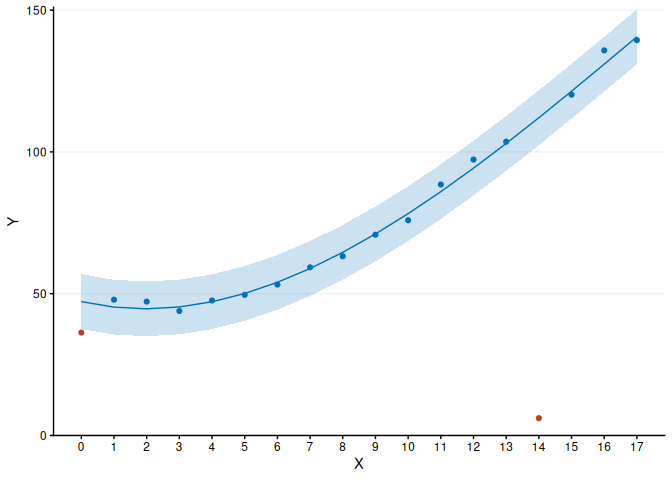
Example: outlier detection
y <- c(36.3, 47.9, 47.2, 43.9, 47.6, 49.6, 53.2, 59.3, 63.2, 70.8, 75.9, 88.5,
       97.3, 103.6, 6.1, 120.2, 135.8, 139.4)
x <- 1:length(y) - 1
fig1 <- OR.outliers.rlm.ggplot(x, y, max.degree = 4, p = 0.0027, x.title = "X",
                               y.breaks = seq(0, 150, 50), y.title = "Y")
print(fig1)